
Tracking crystals evolution during episodes of magma mixing
Episodes of magma mixing due to injection of fresh magma into a
shallow chamber are simulated at first in a Eulerian reference system. Afterwards, the Lagrangian trajectories of passive tracers are computed, tracking the magma composition, pressure and temperature through which these particles move.
On the base of the compositional, pressure and temperature conditions, the crystallizing phases are computed with the MELTS code. The history of accretionary layers is thus obtained by interface-controlled growth and solid-state diffusion.
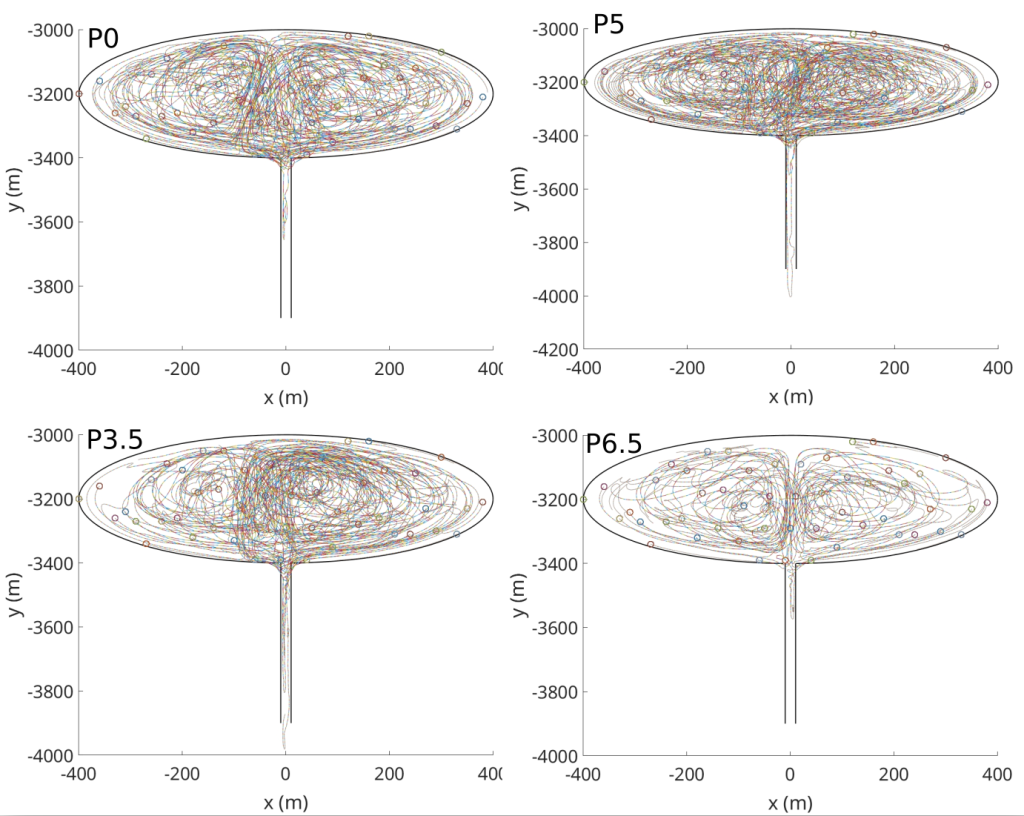
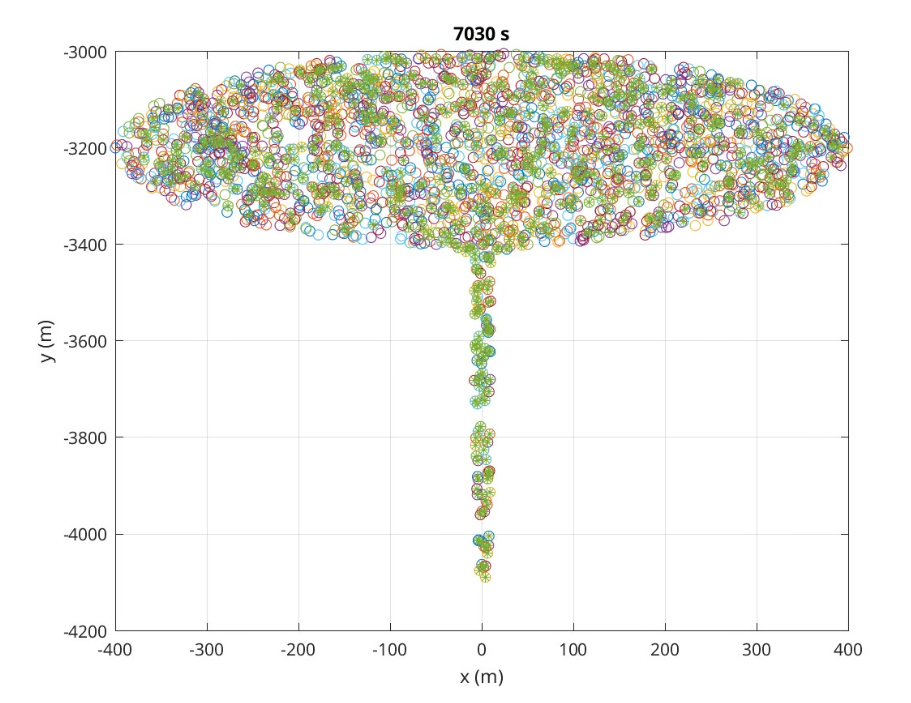
Motion of dispersed crystals.
Mechanisms driving crystallization are: interface-controlled growth, solid state diffusion, and melt diffusion. Among these, it can be demonstrated that the melt diffusive layer is small as convection provides fresh melt for the crystal to growth. Melt diffusion is thus fast with respect to the other two mechanisms. Differently, interface-controlled growth and solid state diffusion may act over similar length scales and has to be considered.
Interface-controlled growth can be expressed as:
where R is the radius of the growing or dissolving crystal, k is an interface-controlled kinetic coefficient, and S is the supersaturation or other normalized growth driving force.
The model assumes as a first-order analysis that the driving force for one solid-state solution (feldspars) is given by:
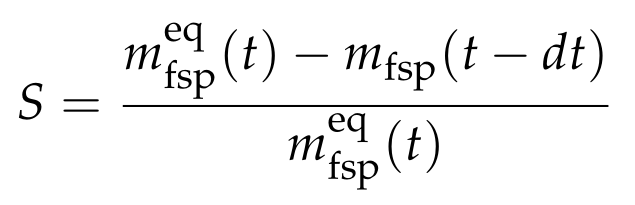
where mfspeq is the equilibrium mass of feldspars computed with MELTS for the local (P,T,X) conditions, and mfsp is the actual mass of crystals carried by the unitary magma parcel. For an advanced treatment, the driving force should be expressed in terms of solid activities, and the correlation between phases of solid solutions should be accounted for. Also the impoverishment of the melt by the crystallizing elements should be considered. To the aim of the new first order analysis the mass criteria is regarded as feasible.
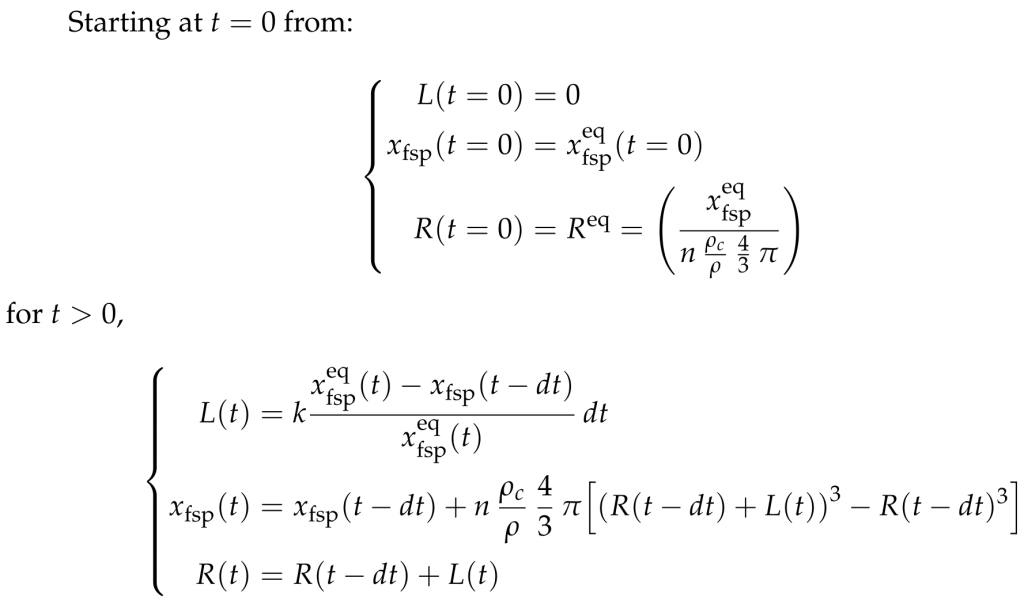
The crystal growth law is thus:

The mass mfsp is computed from the history of growing crystals as:

Therefore, the algorithm for the computation of crystals growth/dissolution is:
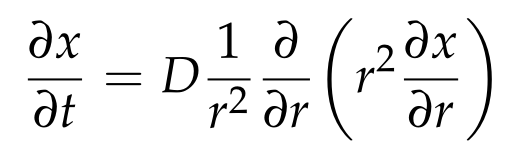
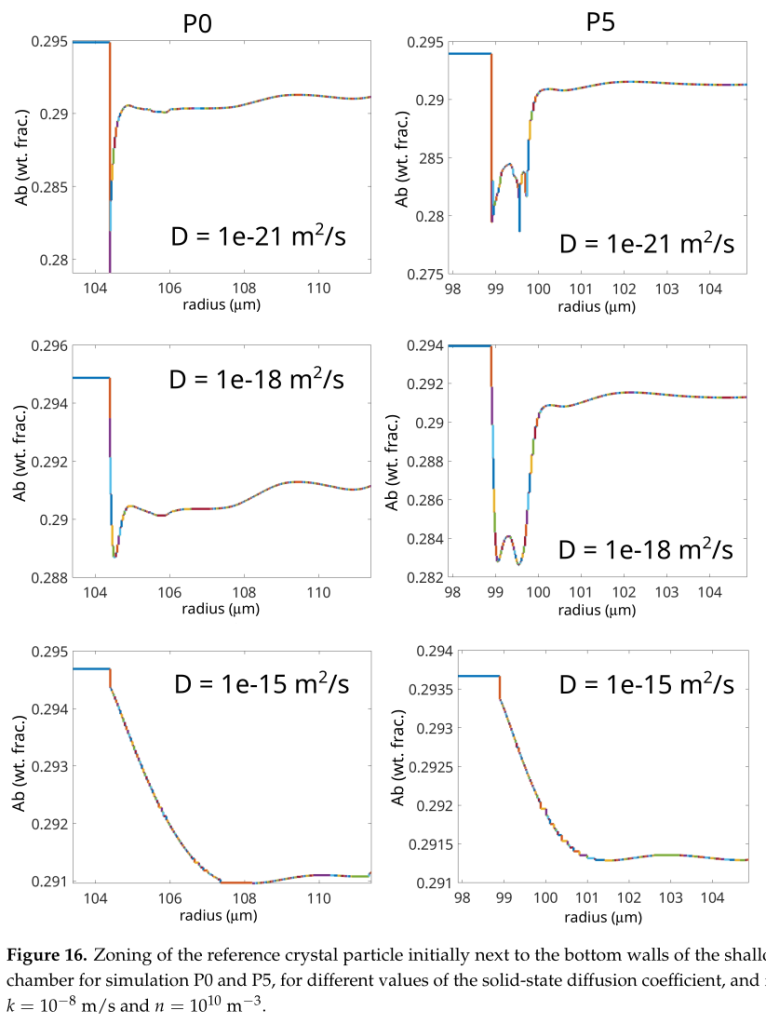
As new rims grow with the equilibrium composition dictated by MELTS, intracrystalline diffusion tends to homogenize them. Solid state diffusion follows the standard diffusive equation:
The local (P, X) conditions sampled by the crystals, and the variations in radius and kinetic proxy are illustrated below for reference particles:
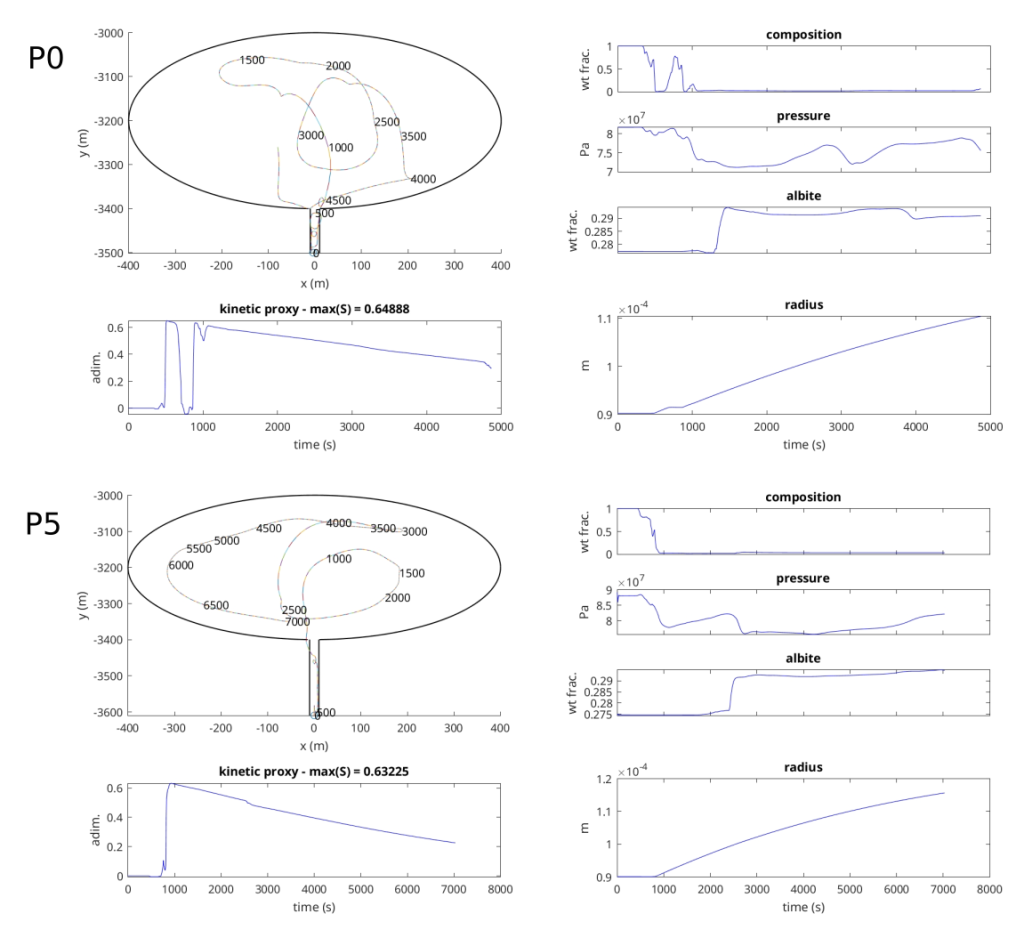
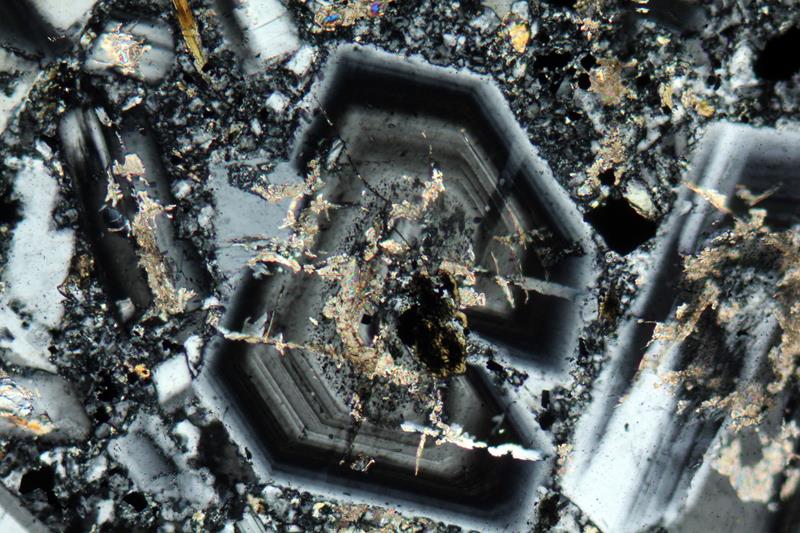
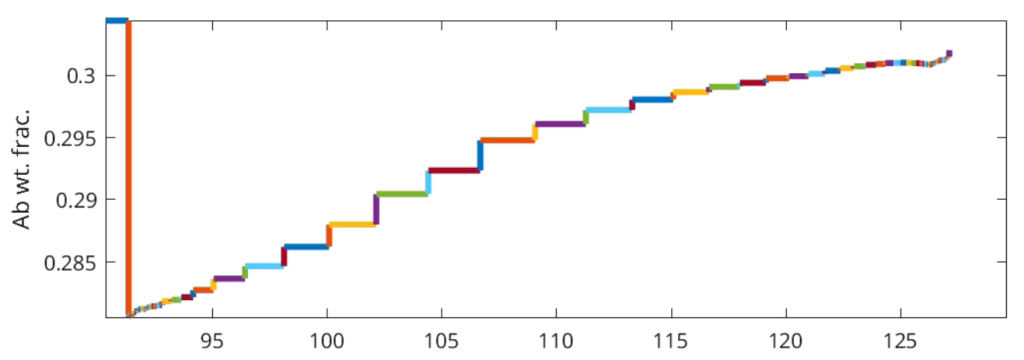
The crystal zoning considering albite as reference phase is reported below:
Proudly powered by WordPress